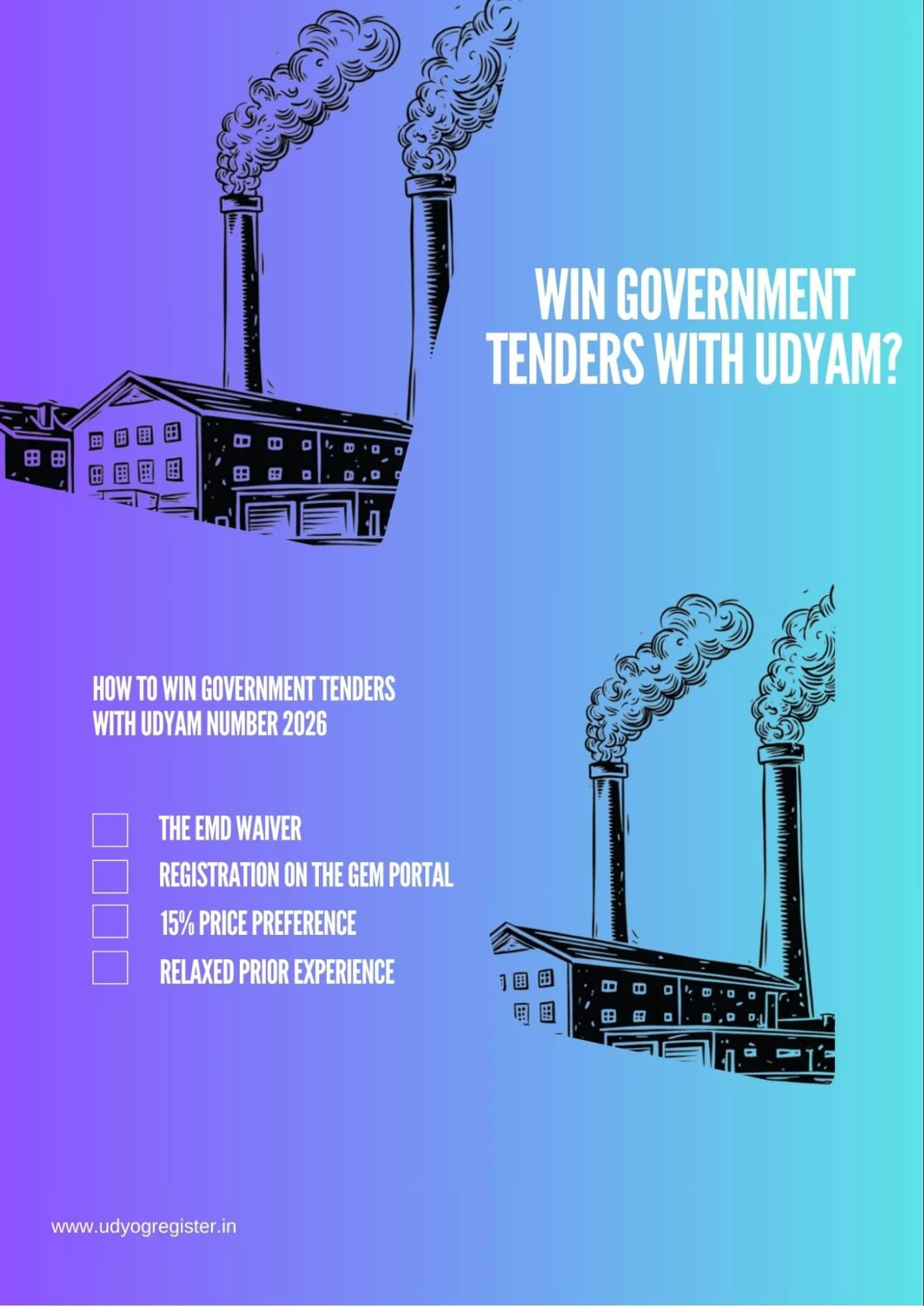
How to Win Government Tenders with Udyam Number 2026

Table Of Content
- Introduction
- 1. The EMD Waiver: Bid Without Paying Earnest Money Deposit
- 2. Mandatory Registration on the GeM Portal
- 3. Relaxed Prior Experience & Turnover Criteria
- 4. Free Tender Sets & Technical Support
- 5. 15% Price Preference Rule
- 3 Mistakes to Avoid When Bidding in 2026
- 6. Tender Process & Documentation
- Common Question and Answer
- Conclusion
In 2026, Central Ministries and PSUs must reserve 25% of their total requirements from MSMEs. If you want to access this 25% reservation, you need a Udyam Registration Number (URN). Here is a full guide on how Udyam registration helps you to win government tenders.
1. The EMD Waiver: Bid Without Paying Earnest Money Deposit
Normally, when a company bids for a government tender, it must deposit 2% to 5% of the tender value as an Earnest Money Deposit (EMD). For a ₹50 Lakh tender, that's ₹2.5 Lakh locked up for months.
The Udyam Advantage: Under the Public Procurement Policy, Micro and Small Enterprises (MSEs) with a valid Udyam Certificate are exempted from paying EMD.
2. Mandatory Registration on the GeM Portal
In 2026, you cannot sell anything to any government office without being registered with the government e-Marketplace (GEM).
The Udyam Connection: Your GeM registration is now seamlessly linked with your Udyam Number.
- Step: During GeM onboarding, enter your URN. The portal will automatically verify your MSME status, category (Micro/Small/Medium), and turnover from the Income Tax database.
- Benefit: This gives you the "MSE" badge on your profile, which filters your products into "Reserved for MSME" search results for government buyers.
3. Relaxed Prior Experience & Turnover Criteria
Prior Experience is one of the biggest hurdles for any startup because you cannot have any experience until you win your first tender.
In 2026, government departments are now encouraged to give some relief on prior turnover and experience for Udyam-registered startups if they have technical specifications and quality standards.

4. Free Tender Sets & Technical Support
Participating in high-value tenders often requires paying a "Tender Fee" or "Document Fee." For MSMEs, most Central Government departments provide these tender sets free of cost.
Additionally, through various MSME-DI (Development Institutes) and NSIC (National Small Industries Corporation) offices, Udyam holders get:
- Free technical counselling for bid preparation.
- Assistance in testing products at subsidised rates to meet tender quality standards.
5. 15% Price Preference Rule
In a tender, usually the company that bids the lowest wins the tender. But Udyam-registered businesses have a unique safety net.
If a company has won a government tender with the lowest bid and a Udyam-registered MSME also bid for the same tender, their bidding price is within the 15% range of the lowest bid. Then the MSME will be given a chance to match the price of that large corporation, and if the MSME agrees to match the same bidding price, then the MSME will receive at least 25% of the total order value.
3 Mistakes to Avoid When Bidding in 2026
- Outdated Udyam Certificate: Before applying for a government tender, ensure your Udyam Certificate is updated with your latest FY 2024-25 turnover. If your turnover has changed, update it promptly.
- Wrong NIC Codes: If your Udyam certificate lists "Service" but you are bidding for a "Manufacturing" tender, your bid might be rejected. Always keep your NIC codes diverse.
- Ignoring the TReDS Integration: If you win a tender, use your Udyam registration number (URN) to register on TReDS (Trade Receivables Discounting System). This ensures you get paid within 45 days, even if the government department delays the payment.
6. Tender Process & Documentation
Documents Required for Tender Process – PAN Card, GST certificate, audited financial statements, proof of experience and technical specifications.
2026 Tender Submission Process: Most of the tender submissions are made through the online portal using a DSC token. Physical documents only allowed for specifically requested verification.
Common Question and Answer
How is AI changing the process?
People use AI to scan government portals and relevant tenders for their business, and check compliance.
What is the "Minimum Number of Bidders" rule?
If fewer than 3 bidders applied for the tender, then the tender might be cancelled or require approval from a competent authority to proceed.
Conclusion
In 2026, the government came up with many schemes to strengthen MSMEs business. If you want to access all of these schemes, your journey starts with a valid Udyam Registration. If you haven't migrated your old Udyog Aadhaar or need to update your 2026 NIC codes, ensure your registration is compliant for the next big tender cycle that begins.